Define the Elements of Art What Are Color Schemes
This is a detailed guide on color schemes. I'll discuss what they are, the different types, and provide master examples.
- What Are Color Schemes in Art?
- Analogous Color Scheme
- Complementary Color Scheme
- Split-Complementary Color Scheme
- Triadic Color Scheme
- Rectangular Color Scheme
- Monochromatic Color Scheme
- Learn More
What Are Color Schemes in Art?
A colour scheme is used to draw the overall selection of colors in an artwork. The major color schemes in art are analogous, complementary, split up-complementary, triadic, rectangular and monochromatic. These color schemes utilize colors at certain locations on the colour wheel.
Before I get into information technology, I should point out that I don't really call back virtually color schemes all that much whilst I'thousand painting. Colour is not then simple that yous can just apply a color scheme and everything volition work out. But it is important that you understand what the popular colour schemes mean every bit they are oft referenced to describe the utilise of color in fine art.
Analogous Color Scheme

An analogous colour scheme uses colors which are next to each other on the color wheel. For example, blues and greens, or oranges and yellows. These colors have a close human relationship with each other.
At that place is not that much hue dissimilarity between analogous colors, so you demand to make sure you are creating enough contrast using the other elements like value or saturation.
When I think of coordinating colors, Claude Monet's paintings first come to listen. In this painting, Monet used by and large dejection and some greens. There is hardly whatever hue contrast in this painting. Monet relied more so on value and saturation contrast.
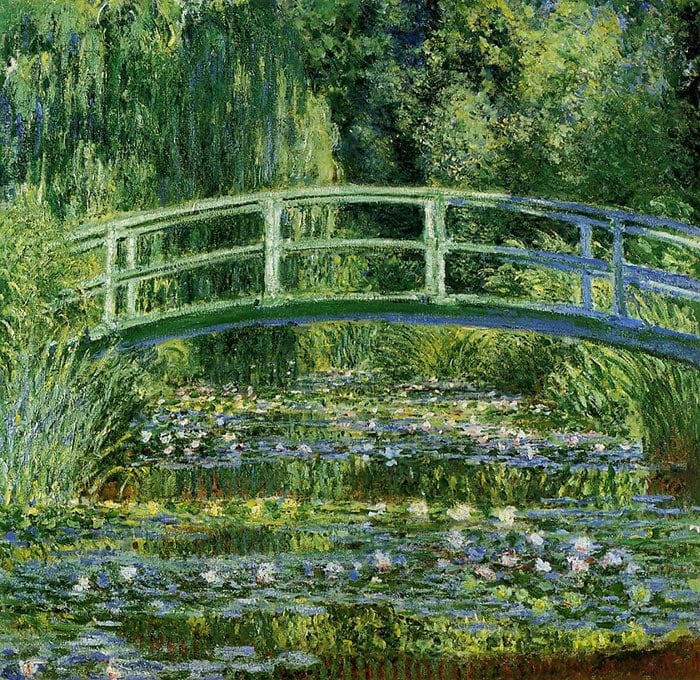
Claude Monet, Water Lilies and Japanese Bridge, 1897-1899
Below is one of Monet'due south paintings from his water lilies series. It features all kinds of greens, blues and purples. In that location are some cherry accents used for the flowers, merely I still consider this to exist an coordinating painting as red is not a dominant color here.

Claude Monet, Water Lilies, 1914-17
In Vincent van Gogh's flower painting below, he used an analogous color scheme of yellows and greens. He too made clever employ of line to outline the flowers.

Vincent van Gogh, A Field Of Xanthous Flowers, 1889
Beneath is awarm coordinating color scheme with more often than not reds, oranges and blacks.

Claude Monet, Dusk On The Seine In Winter, 1880
Complementary Colour Scheme

Complementary colors are opposite each other on the color bike. When placed adjacent to each other, there is an extremely strong contrasting and vibrant effect. If overused, your painting may become jarring and uncomfortable to await at.
Yous should select a dominant color and use the other colour every bit an emphasis. In van Gogh's sunflower painting below, he used a slow background of blue to complement the orangish for the flowers.
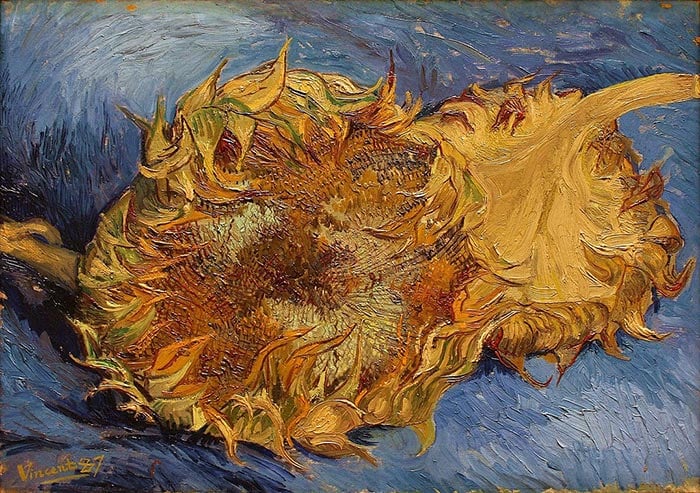
Vincent van Gogh, The Paris Sunflowers, 1887
Hither is some other example of an orangish and blueish complementary colour scheme. In this instance, both colors are relatively strong and they fight for your attending.

Below is a more subtle blue and orange complementary color scheme by John Vocalizer Sargent. The blues of the h2o complement the oranges of the female subject and the shore.

John Singer Sargent, Fisherwoman, 1913
The painting below past Childe Hassam demonstrates only how sophisticated a complementary color scheme can expect. Hassam used directional brushwork, broken colour and value contrast to create such interest with so few colors.

Childe Hassam, Rocks, 1907
Split-Complementary Color Scheme

A separate-complementary color scheme utilizes a base color and two secondary colors. It is similar to the complementary colour scheme, but one of the complements is split.
Below is an example of a carve up-complementary color scheme past Claude Monet, with orangish contrasting against the greens and blues.

Claude Monet, Regatta At Argenteuil, 1872
Triadic Color Scheme

A triadic colour scheme utilizes colors which are evenly spaced on the color wheel. For example, yellow, bluish and orange, like in the painting beneath past Johannes Vermeer.
If using a triadic color scheme, I propose you pick a dominant color and two secondary colors. Otherwise, it would be tricky to balance all three colors without it appearing jarring to look at.

Johannes Vermeer, The Milkmaid, 1658–1660
Rectangular Color Scheme

A rectangular color scheme utilizes four colors positioned effectually the color wheel in the shape of a rectangle. This is a tricky color scheme to manage, as there are four colors involved.
Monet's painting below of poplars features a rectangular color scheme of orange, xanthous, green and purple. Yet, the purple is fairly weak and used more so as a secondary color to complement the stronger greens, yellows and oranges.

Claude Monet, Poplars
In the painting below by van Gogh, there are four fairly distinct color shapes - yellow for the flowers, green for the vase, blueish-green for the wall and a dull orange for the desk-bound.

Vincent van Gogh, The Arles Sunflowers, 1888 (Starting time Version)
Monochromatic Color Scheme
A monochromatic color scheme utilizes just one colour with varying levels of saturation and value. In oil painting, many artists start with a monochromatic layer then build color on top. This mode, the value structure can be established without having to worry virtually multiple colors.
Below are two examples of almost monochrome color schemes for the painting below, with their being mostly varying tones of bluish. But there is some hue variance.

Claude Monet, Morning on the Seine, 1897

Claude Monet, Rouen Cathedral in the Fog, 1894
Acquire More
Color Theory Guide - A comprehensive guide to colour theory for artists. If you lot want to learn more about color and how information technology works, and so starting time hither.
Painting Academy - More details on color and the other fundamentals of painting.
Thanks for Reading!
Thanks for taking the time to read this post. I capeesh information technology! Feel costless to share with friends. If you want more painting tips, check out my Painting Academy course.
Happy painting!

Dan Scott
Draw Pigment Academy
Source: https://drawpaintacademy.com/color-schemes/

Post a Comment for "Define the Elements of Art What Are Color Schemes"